

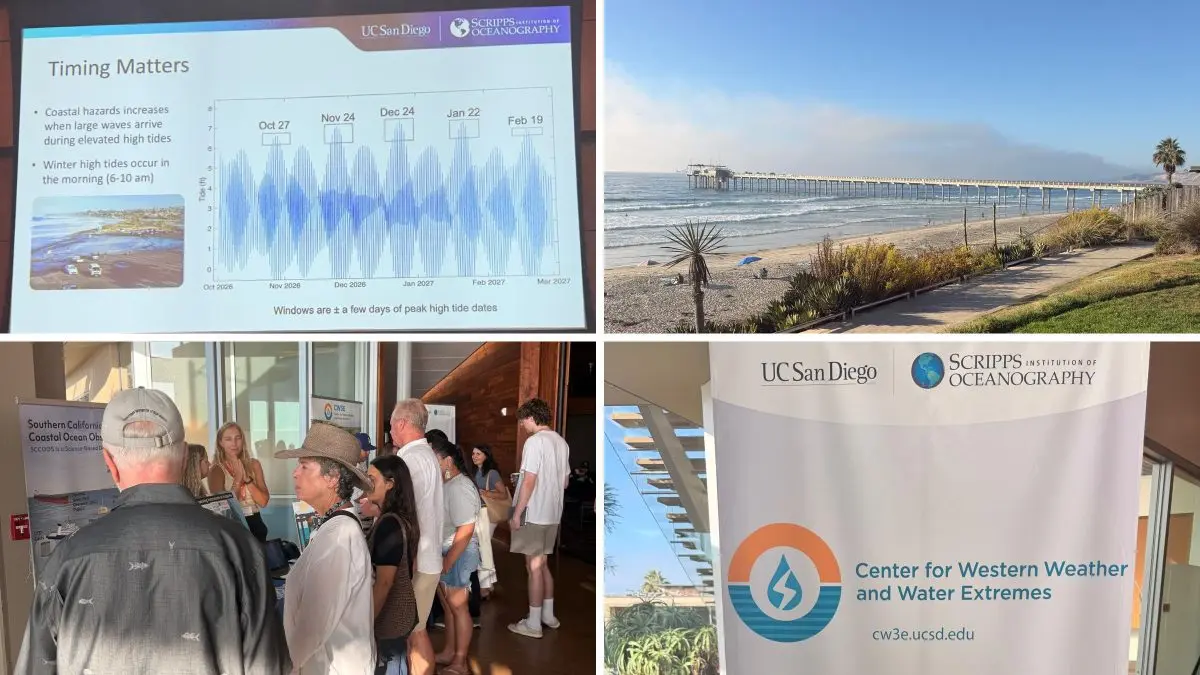
On October 8, Certified Restoration attended a public forum at Scripps Institution of Oceanography during San Diego Climate Week, where ocean scientists, a climate economist, and a National Weather Service meteorologist explained what this winter’s El Niño could mean for San Diego. Their message was the same for a single family home and a 200-unit building: prepare in the fall, because a storm forecast gives you days, not weeks.
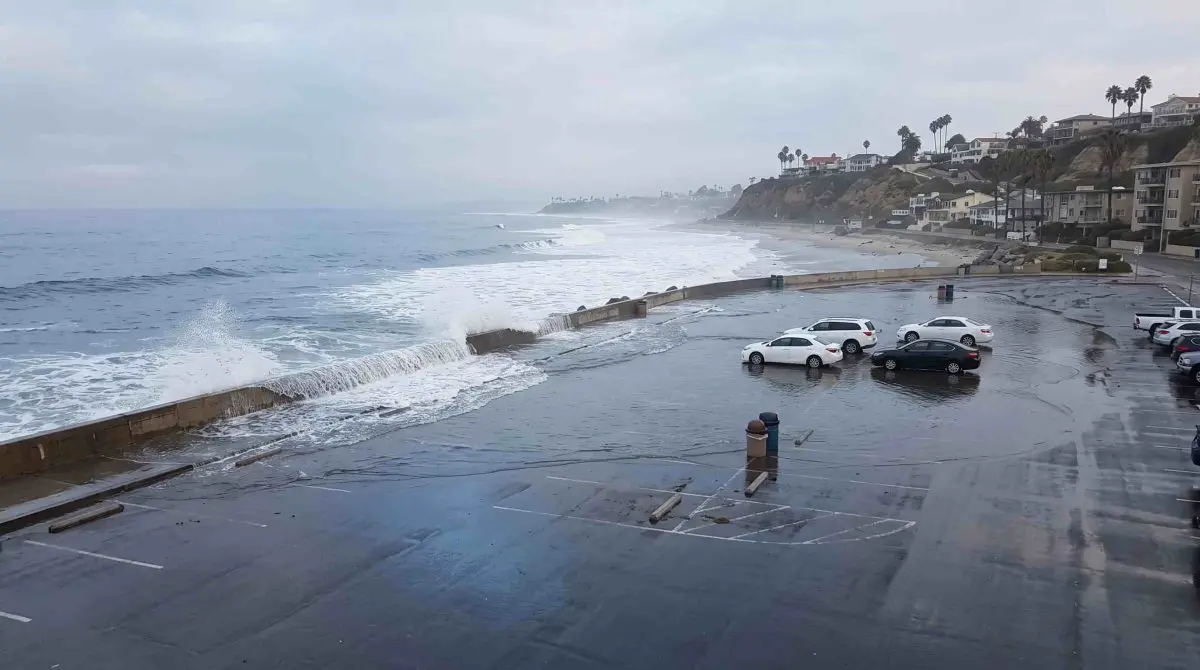
This El Niño is on track to be one of the strongest on record, and it is arriving on an ocean that was already unusually warm. You do not need a record wet season for damage. One heavy storm, like January 2016 or January 2024 in San Diego, is enough to flood a garage, overwhelm a roof drain, or send water under a front door.
Below is what the experts said, followed by separate sections for homeowners and for property managers and HOA boards. Skip to the one that fits you.
What Scripps Scientists Said About El Niño 2026
The ocean started warm. Dr. Daniel Rudnick of Scripps said that El Niño already counts as strong, with central Pacific temperatures more than 2°C above normal. It is stacking on a marine heat wave that has been building off California since early 2025. NOAA’s Climate Prediction Center’s October 8 update puts the odds at 83% that October through December brings a historic event, stronger than any since records began in 1950 (NOAA CPC).
This setup is rare. Melissa Carter, who runs the Scripps Shore Stations Program, manages a temperature record at Scripps Pier that began in 1916. Its 1931 high stood until 2018, and both peaks came when an El Niño and a marine heat wave overlapped, the same pairing forming now.
Rain odds are up, not guaranteed. Sebastian Westerink of NWS San Diego put the chance of above-normal rain at 50% to 60% for January through March. Since 1992, his office has issued a little over twice as many flash flood warnings in El Niño years. Dry, sunny weeks between storms are still normal, which is exactly why deferred repairs get missed.
Atmospheric rivers deliver the damage. Dr. Julie Kalansky, a climate scientist at Scripps’ Center for Western Weather and Water Extremes (CW3E), described El Niño as the setting and atmospheric rivers as the plot. One storm can be helpful. Back-to-back storms are the problem: soil stays saturated, drains never clear, and small leaks become structural water damage (CW3E).
You get about a week of warning. Westerink said forecasters can see an impactful storm five to seven days out, with a clear picture two to four days out. That is enough time for sandbags and drain checks. It is not enough time to fix a roof.
The coast is already a foot higher
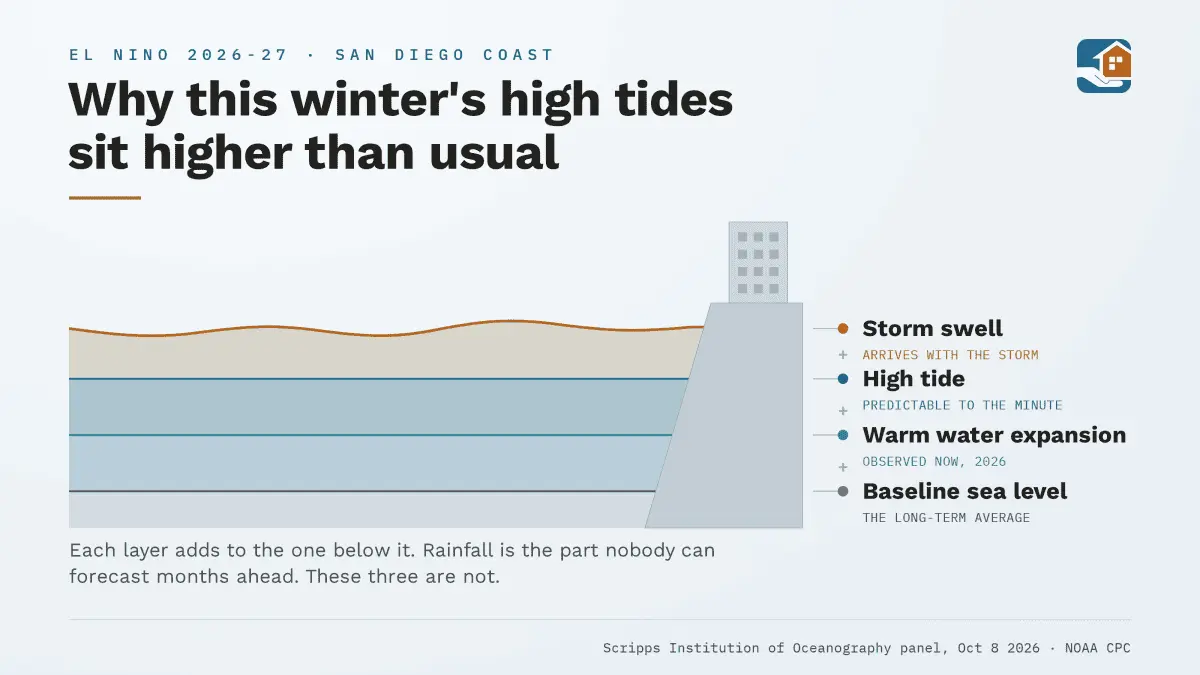
Adam Young, a Scripps coastal geomorphologist, reported that water at the Scripps Pier tide gauge is running more than a foot above normal. September set the highest monthly average in the gauge’s record, above both the 1997 and 2015 El Niños at the same point in the season.
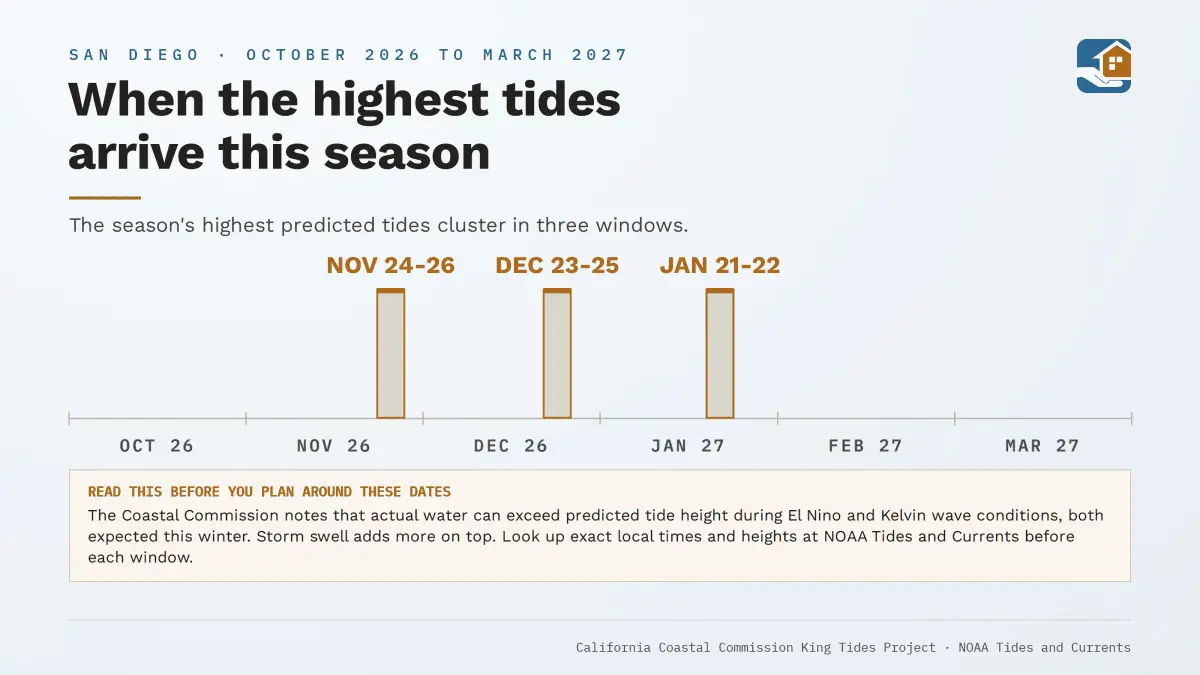
The highest-risk moments come when a big swell arrives during a peak high tide. Young’s predictions put this winter’s windows around these dates, each give or take a few days, with the highest water between 6 and 10 a.m.:
| Peak tide window | Approximate date |
| 1 | October 27, 2026 |
| 2 | November 24, 2026 |
| 3 | December 24, 2026 |
| 4 | January 22, 2027 |
| 5 | February 19, 2027 |
If you own or manage property near the beach, a bluff, or a low-lying street, put these dates on your calendar and watch the surf forecast for each one (California King Tides Project).
For San Diego homeowners: where water gets in
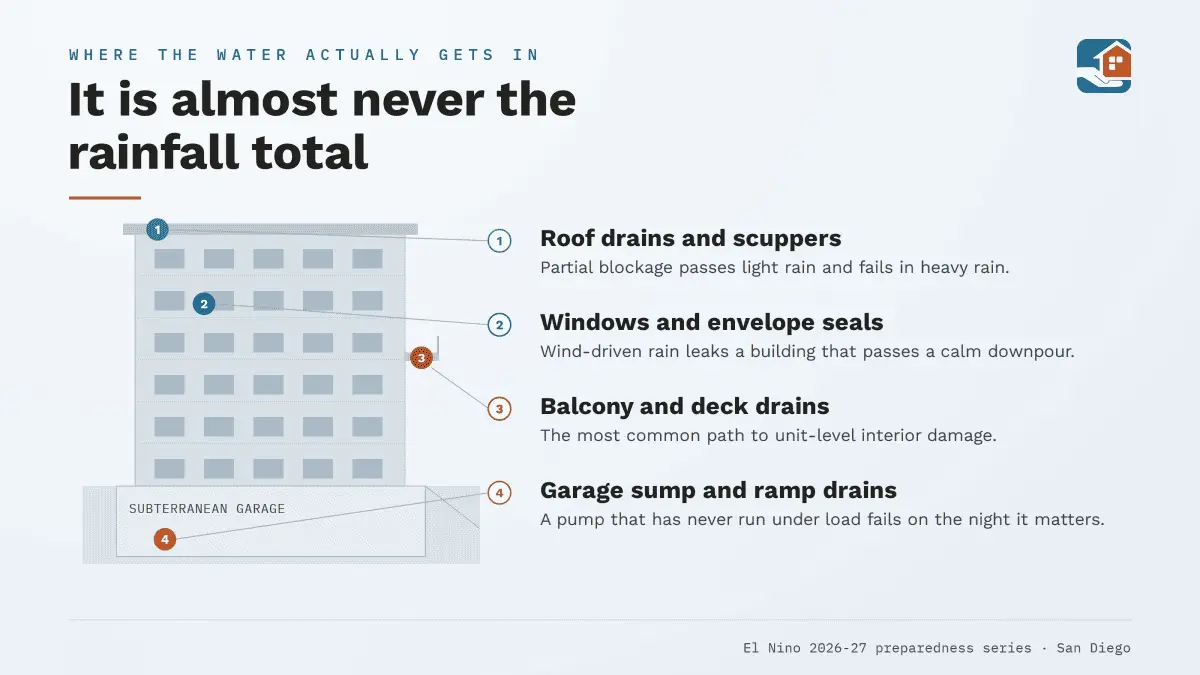
Most storm water damage in San Diego homes starts in a handful of places. Check these before November:
- Roof and gutters: a dry year leaves gutters and downspouts full of debris, and water backs up under shingles and into walls.
- Grading and yard drains: if soil slopes toward the house, water collects at the foundation and finds its way into crawl spaces and slab edges.
- Doors, windows, and sliders: worn seals and blocked weep holes let wind-driven rain inside, often unnoticed until flooring buckles or mold appears.
- Garages and low entries: these flood first when street drains back up.
A weekend list you can do yourself:
- Clear gutters, downspouts, and yard drains, and make sure downspouts discharge away from the house
- Find your main water shut-off valve and make sure everyone in the house knows where it is
- Buy sandbags or flood barriers for the garage and any low doorway
- Look up your address on FEMA’s Flood Map Service Center and call your insurance agent (see the insurance section below)
- Photograph your home’s condition now, so you have a baseline for any claim
- Save a 24/7 water damage company’s number in your phone before you need it; if water gets in, many will talk you through first steps by phone
If water does get in, start drying within 24 to 48 hours. After that, mold growth and claim disputes both get harder to stop.
Homeowner El Niño guide · Flooded? Call 24/7 for a phone consultation: (619) 234-2500
For property managers and HOA boards: one failure, many units
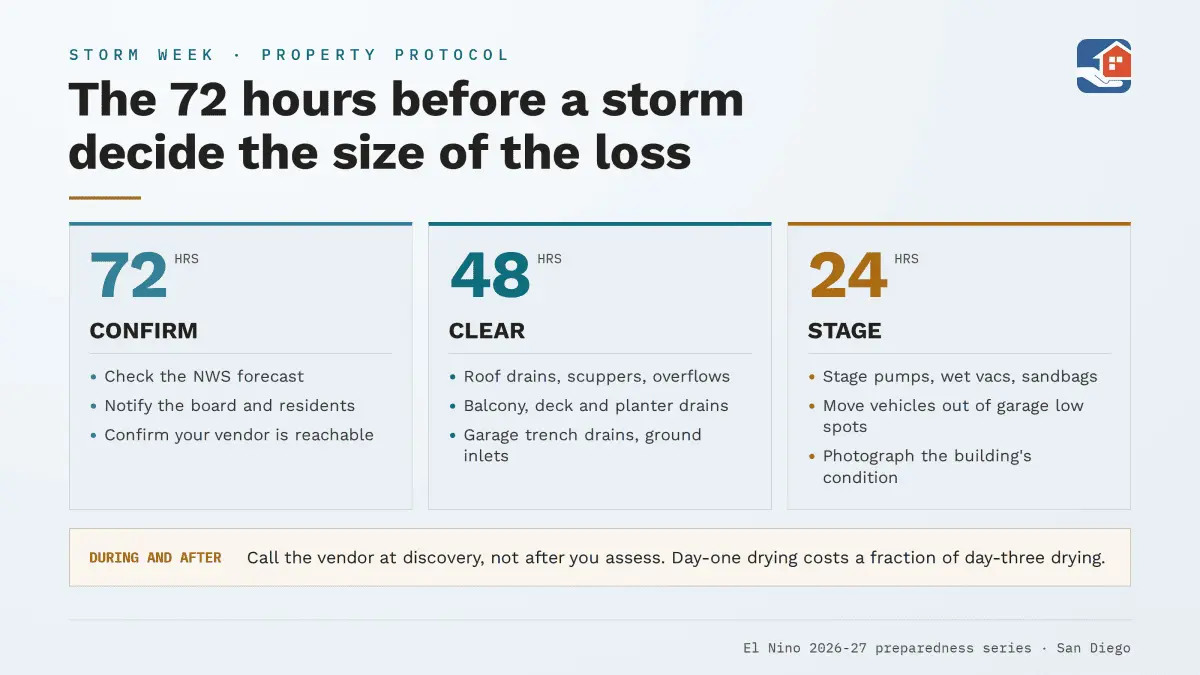
In a shared building, one clogged roof drain can reach a dozen units, a parking garage, and a business interruption claim. These are the failure points by building type:
| Building type | Where storm water damage usually starts |
| HOA and condo | Flat roofs and scuppers, subterranean garages, balcony and deck waterproofing |
| Multi-family rental | Roof drains, sewage backups into ground-floor units, sump pumps in garages and elevator pits |
| Commercial office | Roof drains and penetrations, below-grade mechanical rooms, business interruption |
| Retail | Storefront water intrusion, parking lot drainage, inventory on the floor |
| Coastal or bluff-top | Seawalls, storm drain backflow valves, slope drainage, ground-floor units |
Preparedness Is a Calendar Decision
The calendar matters more than the forecast. Preparedness isn’t a mindset; it’s a set of approvals made before the first storm. Repairs approved in a Q4 budget can be finished before January. Repairs approved after the first storm are emergency work, at emergency prices, with residents or tenants already displaced.
Three preparedness steps to take this fall:
- Inspect before the season. Schedule a pre-season inspection of roofs, drains, below-grade spaces, and the building envelope, so the board or owner gets a prioritized repair list it can approve now.
- Budget for the storm you can’t predict. Add a storm contingency line to the 2027 operating budget.
- Line up your response team in advance. Pre-approve a 24/7 water mitigation vendor. When a storm hits the whole county at once, buildings with an agreement in place get crews first.
A prepared building isn’t one that avoids every storm. It’s one where the decisions are already made when the water arrives.
Flood insurance has a 30-day wait
Tom Corringham, a Scripps climate economist who studies the cost of extreme weather, gave the panel’s most practical advice: check your insurance now. Standard homeowners and property policies typically cover water from inside, such as a burst pipe, but not flooding that comes in from outside.
A new National Flood Insurance Program policy generally takes 30 days to take effect. If you wait for the first storm warning, you are already too late for that storm.
- Homeowners: ask your agent whether your policy excludes outside flooding and what a flood policy would cost for your flood zone.
- Condo owners: your HOA’s master policy and your own HO-6 policy cover different things. Ask both your agent and your board what each one pays for.
- Property managers and boards: have your broker review the master policy’s water damage coverage, deductibles, and flood exclusions this month.
Get ready before the first storm
For 35+ years, Certified Restoration has responded to San Diego storms around the clock for homeowners, HOA boards, and property managers. We help property managers and HOA boards find the weak points before winter. If water gets into your home, call us any time for a phone consultation on what to do next.
- Homeowners: [Flooded? Call 24/7 for a phone consultation: (619) 234-2500]
- Property managers and HOA boards: Interested in creating an Emergency Preparedness Plan (EPP) for your HOA, multifamily, or commercial building? Call us at (619) 234-2500 or Schedule a 15-minute call with our EPP consultant.
Useful free resources: NWS San Diego for flood watches and warnings, FEMA’s Flood Map Service Center for your flood zone, and the California King Tides Project for coastal high tides.
Sources
- Presentations and audience Q&A with Dr. Daniel Rudnick, Melissa Carter, Adam Young, and Tom Corringham (Scripps Institution of Oceanography), Sebastian Westerink (NWS San Diego), and Dr. Julie Kalansky (CW3E, Scripps Institution of Oceanography), Scripps public forum, San Diego, 2026
- NOAA Climate Prediction Center, ENSO Diagnostic Discussion
- CW3E, atmospheric river scale
- California Coastal Commission, California King Tides Project
- FEMA Flood Map Service Center
Disclaimer
This article is for general information ONLY and is not intended to be legal, medical, or scientific advice. The proper approach to each project must be determined on a case-by-case basis. Certified Restoration always recommends that you call a certified restoration professional, especially when there are children, elderly, or individuals with health conditions residing in the property.